
Sunday, July 26, 2015
Sifting the Past at Priory Country Park
Never mind the weather! We'll be investigating at the Park's past, both distant and recent, again today. Come along and have a go at wattle and daub making….!


Friday, July 24, 2015
Wonderful Weekend at Willington
Last month on the 27th and 28th June SAW youngsters helped out with the test pit excavation at Willington Dovecote.
 Orgainsed by Dorothy Jamieson, overseen by National Trust archaeologist, Angus Wainwright and supervised by Jeremy Oetgen and Helen Parslow from Albion Archaeology, the dig took place over two days, with help from local adult volunteers.
 Two pits, one dug by the adults and the other by SAW, gave up a great deal of building materials, including roof tiles, flag stones and lots of brick!

 More exciting finds included a fragment of an iron implement, ceramic sherds and a piece of medieval glass recovered from an excavated hole in the floor of the Tudor stable building.

The Archaeological Fair on Sunday afternoon brought many visitors to site to share in the discoveries and the story of the historic site.


 More exciting finds included a fragment of an iron implement, ceramic sherds and a piece of medieval glass recovered from an excavated hole in the floor of the Tudor stable building.
The Archaeological Fair on Sunday afternoon brought many visitors to site to share in the discoveries and the story of the historic site.

Wednesday, March 25, 2015
NEWS
Just to make sure that you knew...


is now a
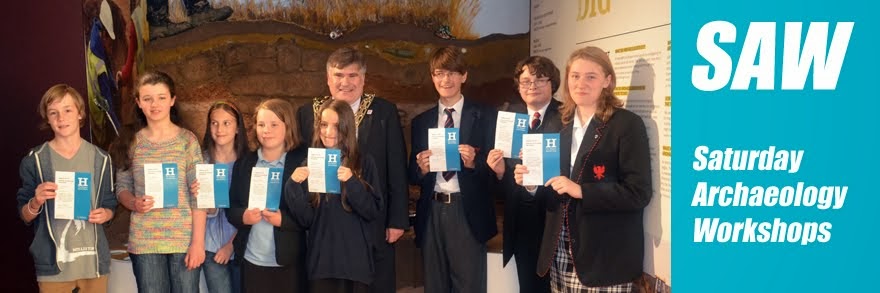
Saturday Archaeology Workshops, based at The Higgins Bedford with archaeologists from Albion Archaeology is now an affiliated branch of the Young Archaeologists' Club.


Tuesday, September 2, 2014
Please Comment
Jack, Oliver and Charlie are coming to the end of their Silver Arts Award, please can you leave comments for them here: Gallery, here: War Art by Thomas Hennell
and here: Bronze Exhibition and Visit to Twinwood Museum
This comment came via Twitter:

and here: Bronze Exhibition and Visit to Twinwood Museum
This comment came via Twitter:
Wednesday, July 23, 2014
SAW at Highlighting History - 26th & 27th July 2014
Part of the Festival of British Archaeology
Come and catch up with SAW at their excavation at Priory Country Park on Saturday 26th and Sunday 27th July, between 12.00pm and 4.00pm. This excavation is in its fourth year, looking for evidence of past uses and occupation of the park site, specifically searching for further evidence of Roman presence.
Visit the dig site, see the latest finds and find out more about SAW.
We hope to see you there!
STOP PRESS: Saturday 26th July FREE guided heritage walk around Bedford River Valley Park at 1pm.
The walk should last around 2 hours. More information from Priory Country Park rangers 01234 211182

You can also find out about other Heritage sites in the area of Bedford River Valley Park, at Willington and beyond. Visit the exhibition in the Priory Country Park Visitor Centre.
For more information visit: http://www.priorycountrypark.co.uk/park_info.html
Friday, July 18, 2014
War Art by Thomas Hennell reviewed by Jack
Visit to RAF Hendon to view war art by Thomas Hennell
On the 11th of April
I went to RAF Hendon to see some of Thomas Hennell's war art. He worked in Asia
(namely India and Burma) as well as other places such as Iceland and the
Netherlands. Most of his work at RAF Hendon is from his time in Asia -
especially in India where he recorded many airstrips being constructed.
 In this picture Indian troops are constructing a
British airfield using out-of-date machinery such as the steam roller in the
background. Due to the nature of his subject and the fact that they were
constantly moving, Hennell had to paint extremely quickly using loose brush strokes. In most of his pictures
he has not used pencil to mark out any shapes. However, when he does use pencil
it is only to show position and outline rather than detail. As is shown in this
painting the heat was unbearable and was only relieved by a monsoon. Both of
these types of weather would have hindered Hennell as he tried to paint. On
these primitive airfields shelter was rare so
Hennell was often rushed to do his paintings and therefore his work appears unfinished; as is shown in this picture
by the seated figure in the foreground. By the time the storm on the horizon
had passed this figure would have moved so the painting could not be completed.
In this picture Indian troops are constructing a
British airfield using out-of-date machinery such as the steam roller in the
background. Due to the nature of his subject and the fact that they were
constantly moving, Hennell had to paint extremely quickly using loose brush strokes. In most of his pictures
he has not used pencil to mark out any shapes. However, when he does use pencil
it is only to show position and outline rather than detail. As is shown in this
painting the heat was unbearable and was only relieved by a monsoon. Both of
these types of weather would have hindered Hennell as he tried to paint. On
these primitive airfields shelter was rare so
Hennell was often rushed to do his paintings and therefore his work appears unfinished; as is shown in this picture
by the seated figure in the foreground. By the time the storm on the horizon
had passed this figure would have moved so the painting could not be completed. In this piece of
artwork Pioneers are laying an airstrip in Mingaldon, June 1945. This shared
airfield housed both American and British Dakotas as well as American
Liberators. In this image Hennell has used very suggestive colours that you
would not expect to see in a normal scene.
In this particular painting Hennell has put varying shades of pink in
the foreground and blue in the middle-ground. These colours create a sense of
movement and action within the scene because of their loose and inaccurate
personality. He has used various contrasting techniques in this piece of art
such as wet-into-wet and dry-brushing. In the central foreground yellow ochre
and mid purple have been dry-brushed together leaving speckled white areas
which again add a sense of movement. On the left browns and yellows have been
used wet-into-wet to create a fading look which has aided perspective. The
planes in the background are also very suggestive which means that they
compliment the scene without detracting attention from the Pioneers.
In this piece of
artwork Pioneers are laying an airstrip in Mingaldon, June 1945. This shared
airfield housed both American and British Dakotas as well as American
Liberators. In this image Hennell has used very suggestive colours that you
would not expect to see in a normal scene.
In this particular painting Hennell has put varying shades of pink in
the foreground and blue in the middle-ground. These colours create a sense of
movement and action within the scene because of their loose and inaccurate
personality. He has used various contrasting techniques in this piece of art
such as wet-into-wet and dry-brushing. In the central foreground yellow ochre
and mid purple have been dry-brushed together leaving speckled white areas
which again add a sense of movement. On the left browns and yellows have been
used wet-into-wet to create a fading look which has aided perspective. The
planes in the background are also very suggestive which means that they
compliment the scene without detracting attention from the Pioneers. Many techniques have been used in this picture such as
dry-brushing and the addition of neat water droplets. Hennell appears to of
laid down a wash and then leaving it to semi-dry before adding water
droplets. These drops have created a
pale starburst effect which helps to add
texture to the ground. Another method of adding texture is through the use of
dry-brushing. He has left large expanses of white paper showing after laying
his washes. In these spaces Hennell has added dabs of colour or dry-brushed colours
across the rough paper. These two simple effects come together to create a
convincing suggestion of rough ground.
Many techniques have been used in this picture such as
dry-brushing and the addition of neat water droplets. Hennell appears to of
laid down a wash and then leaving it to semi-dry before adding water
droplets. These drops have created a
pale starburst effect which helps to add
texture to the ground. Another method of adding texture is through the use of
dry-brushing. He has left large expanses of white paper showing after laying
his washes. In these spaces Hennell has added dabs of colour or dry-brushed colours
across the rough paper. These two simple effects come together to create a
convincing suggestion of rough ground.
To create the effect of rain in the sky, Hennell appears to
of flicked on water again and has also dragged colour across the sky. It seems
that he has used the equivalent of a fan brush in order to streak the 'rain'
across the grey wash of a sky. Along the base of the picture Hennell has added
horizontal brush strokes of varying shades of brown. the horizontal nature of
the loose strokes means that they show the contour of the bare soil extremely
well along with the corresponding washes.

Overall, Hennell has a very unique painting style in which
he uses unexpected techniques to create varying effects that help to add
character to his paintings. The fact that he paints so quickly using these
impressionist techniques means that his paintings have a sense of movement and
a reality that is not immediately portrayed.
 Whilst I was there I
also saw some works by Stafford-Baker - an un-commissioned war artist. Stafford-Baker's style is very much like my
own, he pays very close attention to detail and colour as well as how the light
reflects off of different surfaces. The detail on the relatively small
Beaufighter in the background is precise - right down to the hair-line panel
recesses. The foreground Beaufighter with the engine cowling removed also
portrays exquisite detail within the engine bay. Despite the limited light Stafford-Baker has
shown the prop boss and pistons extremely well using light and shadow to show
shapes. Stafford-Baker has used wet-into-wet techniques to show light and dark
without obvious transitions. Overall this study is amazingly
Whilst I was there I
also saw some works by Stafford-Baker - an un-commissioned war artist. Stafford-Baker's style is very much like my
own, he pays very close attention to detail and colour as well as how the light
reflects off of different surfaces. The detail on the relatively small
Beaufighter in the background is precise - right down to the hair-line panel
recesses. The foreground Beaufighter with the engine cowling removed also
portrays exquisite detail within the engine bay. Despite the limited light Stafford-Baker has
shown the prop boss and pistons extremely well using light and shadow to show
shapes. Stafford-Baker has used wet-into-wet techniques to show light and dark
without obvious transitions. Overall this study is amazingly
detailed and, if it had been finished, would have made a
fine painting.
I like Stafford-Baker's work very much because he uses various
techniques to create a realistic painting that appears to be alive. However, I
feel that Hennell paints movement into his paintings much better - probably
owing to the hurried nature of his paintings. Despite this Hennell has not
included much detail in his paintings and therefore I find it hard to relate to
them like I can to Stafford-Baker's. My painting style is more like
Stafford-Baker's and therefore I think
that I prefer his work - even though they are both equally as impressive. This
article focuses mainly on Hennell because his paintings use interesting
techniques that I can use and I can therefore aspire to create paintings like
his (only with a bit more detail!). As mentioned previously, Hennell has also
used various colours within his paintings that you would not normally expect to
find, which creates an interesting effect that I would like to try on my
paintings.
Jack
Jack
Subscribe to:
Posts (Atom)